

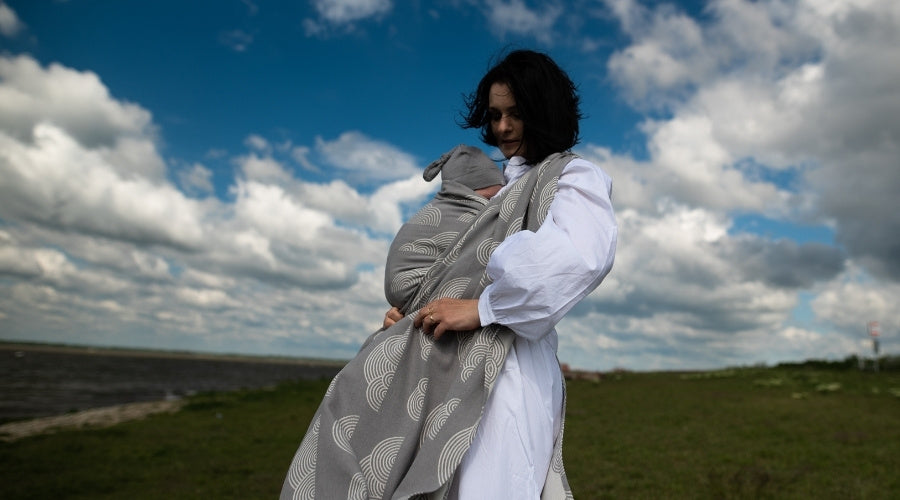

Babies cry for many reasons. If they cry or resist when you put them in a carrier or wrap, it doesn’t necessarily mean the carrier is the problem. Something might hurt, or they might simply be having a bad moment.
Babies are “used to” being carried since their time in the womb. Babywearing is all about the contact they want and need. Carriers and wraps are simply tools that keep you close during everyday activities.
Try to notice when your baby cries and signals that something isn’t right. There can be several reasons:
Crying as soon as you put them in the carrier or wrap
- Too tight. Some babies like to be held more snugly, others less. Tighten slowly, watch your baby’s reactions and adjust the whole wrap to their needs.
- It can also depend on the “phase” your baby is in when you put them in. They may be overtired or want to do something else – pass a stool, breastfeed, etc. You can offer the breast in the wrap to calm them. Babies carried right from birth, on the other hand, usually settle within seconds of being put in a carrier.
- Babies who weren’t carried from birth, but only after a few months, may resist because they don’t know what’s happening. They don’t realise you’re putting them into a position they know and that soothed them for 9 months. They need to experience it and remember it again.
- Some prefer a wrap, others a carrier. Sometimes changing the carrier works wonders and the baby stops crying. Carriers often have a fixed panel width between the legs that prevents a natural spread (mostly an issue for smaller babies, which is why a wrap is usually recommended up to about 3 months) – except for adjustable carriers. A wrap can be adapted perfectly to your baby, but sometimes a carrier suits them better.
- They want to see. Bigger, more curious babies (you may notice this even at three months) don’t want to be in a front carry when they’re awake – they want to look around. They may protest as you put them in, or after a few minutes. We recommend a hip or back carry.
- Impatience. Smaller babies are usually impatient to get their milk as soon as possible – offer the breast while you’re tying. Older babies don’t want to wait through the “endless” tying. Then it’s better to choose a carrier you can put on quickly (a buckle carrier or a ring sling).
- Mum’s closeness stimulates sucking. Being close to mum triggers the need to suckle – which is why babywearing is recommended during nursing strikes. As above, offer the breast while tying.
Offering the breast right at the start of tying reduces your baby’s stress, and you’ll recognise and respond to their signals even better.
It also works really well to get your baby into the carrier as best you can in the moment (whether or not the position is perfect – when they’re arching in your arms, that isn’t ideal either) and head straight outside, onto the balcony, anywhere – just change the scenery. Fresh air, movement, rocking, bouncing, rhythm or breastfeeding in the carrier help a lot. Once your baby has calmed down and relaxed, you can move them into the “correct” position.
If you’re a beginner, use these tricks right from your first practice sessions. They’ll also ease your own stress about the technique. A crying baby raises your stress hormones too, and until tying becomes second nature, it’s hard to focus on tying and watching for signals at the same time.

Crying after a few minutes of babywearing
You tied a happy baby into the wrap, but after a few minutes they become restless. Or they fall asleep and wake up crying hard. There may be several reasons:
- They may have been in a certain sleep phase, something woke them and startled them. They need to calm down again. Breast, rocking, singing.
- A bad dream, processing stimuli. Breast, rocking, singing.
- Sudden discomfort related to passing a stool, wind, digesting food or milk and burping. The position they’re in may be pressing on them at that moment. Try lifting your baby slightly in the carrier with your hands. If that doesn’t help, there’s no relief (stool, burp, wind) and your baby won’t take the breast either, take them out of the carrier completely. The cause usually becomes clear then. Some babies cry when they need to go and are on mum, because they don’t want to do it on her (look up elimination communication to learn more). Once your baby feels better, put them back in the carrier or wrap.
- Temperature changes. Your baby may be too hot or too cold in the wrap. If too hot, choose a more breathable wrap or carry (Kangaroo, simple cross, Double Hammock, ring sling, Rucksack on the back; generally single-layer carries without fabric wrapping the sides) or a carrier that lets air flow in from the sides. If too cold, add a warm layer – a babywearing jacket, hoodie or cover.
There can be countless reasons, and it’s up to you to work out which one applies. It may not even be the same every time. Once their feet are cold, next time they’re startled, then they need the toilet… or it may be something else entirely.
Strong, persistent crying – not just in a carrier – needs a different approach, as its trigger may go back to the prenatal period. You can read about the psychology of crying in Naomi Aldort’s book Raising Our Children, Raising Ourselves. It applies to newborns, infants and older children alike.
Like breastfeeding, babywearing is the most natural and familiar thing for babies – and yet they sometimes struggle with it. With the right help, “the problem” can be solved, either straight away or over time.


Leave a comment
This site is protected by hCaptcha and the hCaptcha Privacy Policy and Terms of Service apply.